
God Does Not Forget—And That’s Good News
/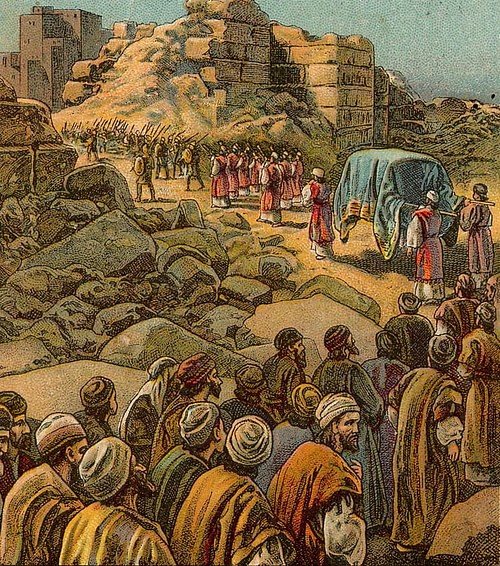
The Israelites Capture Jericho
Providence Lithograph Company (Public Domain)
There are moments when life moves on so completely that it feels as if the past has faded away. Promises once spoken are forgotten. Warnings once heard are muted by time. We forget—but God does not. And Scripture shows us that God’s memory is not something to fear, but something to trust.
Two verses, separated by generations, quietly testify to this truth: Joshua 6:26 and 1 Kings 16:34.
A Word Spoken, A Promise Kept
After God supernaturally brought down the walls of Jericho, Joshua issued a solemn declaration: the city was not to be rebuilt. Jericho would stand as a testimony—both to God’s power and to His authority. The victory was unmistakably divine, and the aftermath was meant to remain so.
Years passed. Leaders rose and fell. Israel settled into the land. Jericho itself was occupied again in various ways, yet no one attempted to restore it to its former fortified strength. Time might have suggested that Joshua’s words were no longer relevant.
But God had not forgotten.
When Memory Meets Meaning
In the reign of Ahab, a man named Hiel undertook the first serious attempt to refortify Jericho. What may have looked like progress or ambition was actually a direct challenge to a word God had already spoken. And Scripture tells us—briefly but clearly—that Joshua’s prophecy was fulfilled exactly as declared.
The placement of this account in 1 Kings is striking. It seems almost out of place among the political and religious developments of Ahab’s reign. But that may be precisely the point.
Just as God’s word stood firm regarding Jericho, so it would stand firm regarding Israel’s idolatry. Ahab was establishing a system of worship God had already declared He would judge, much like Hiel was attempting to rebuild a city God had already condemned. The message is subtle but powerful: God’s word does not expire.
A Hope-Filled Reminder
While the consequences in these passages are undeniably serious, the heart of the message is deeply encouraging. God’s faithfulness works both ways. If He remembers His warnings, He also remembers His promises. If His word of judgment stands, how much more does His word of mercy, restoration, and life stand firm?
We may forget prayers we once prayed, truths we once held dear, or commitments God once spoke into our lives. But God does not forget. He remembers every promise, every purpose, and every plan He has declared.
And that means we can trust Him—even when time has passed, circumstances have changed, or memories have faded. God’s word is steady. His faithfulness is enduring. And His remembrance is always working for His glory and our good.
