
The Faith of a Survivor
/Text: 1 Kings 18:1–16
Introduction
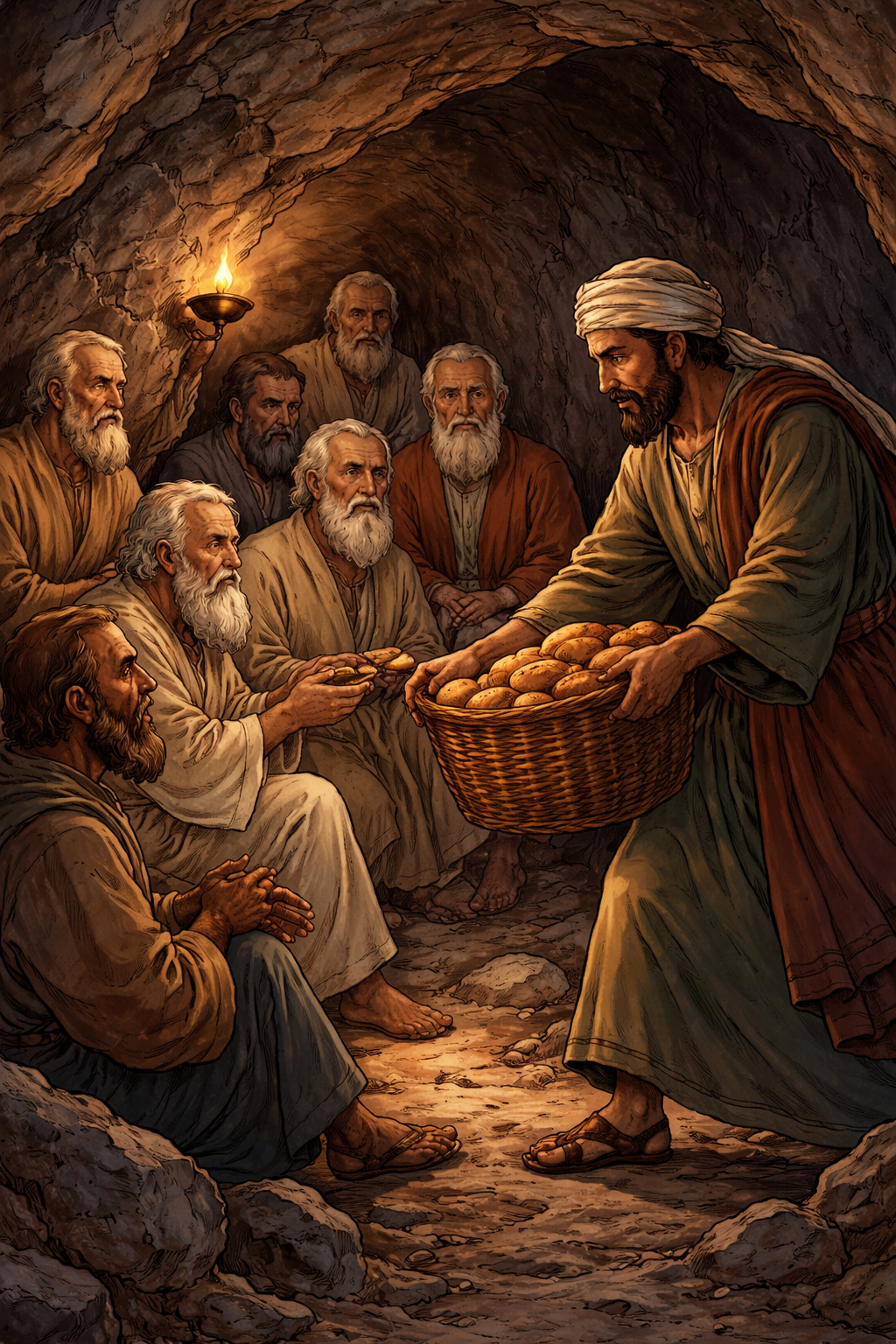
Obadiah hiding prophets in caves during the reign of Ahab
Obadiah appears in one of the darkest chapters in Israel’s history. Under King Ahab and Queen Jezebel, the nation had sunk deeply into idolatry, persecution, and moral corruption. The prophets of the Lord were being hunted down and executed, and Elijah himself had become a wanted man throughout the kingdom.
Yet in the middle of this darkness stands an unlikely hero—Obadiah. Scripture introduces him with a simple but powerful statement: “Now Obadiah feared the LORD greatly” (1 Kings 18:3, KJV).
Obadiah served as the governor of Ahab’s house, essentially the chief steward of the royal palace. From the outside, it may have looked like compromise to serve in such a corrupt administration. But behind the scenes, Obadiah was risking his life to protect God’s servants. When Jezebel ordered the slaughter of the prophets, he secretly hid one hundred of them in caves and provided them with bread and water.
Obadiah is a powerful picture of a survivor—someone living under constant pressure, danger, and spiritual conflict. He carried burdens few people saw. Yet he remained faithful.
His very name means “servant of Yahweh.”
His story teaches us that even those who survive seasons of trauma, fear, and darkness can still live a life of deep faith and quiet courage.
I. Survivors Choose Reverence for God in the Midst of Darkness
“Now Obadiah feared the LORD greatly.” — 1 Kings 18:3 (KJV)
One of the most remarkable things about Obadiah is where he lived out his faith. He served in the palace of the most wicked royal couple Israel had known. Ahab and Jezebel had turned the nation toward Baal worship and violence against God’s prophets.
Yet Obadiah still feared the Lord.
An inscription discovered after World War II captures this kind of faith:
“I believe in the sun even when it is not shining.
I believe in love when feeling it not.
I believe in God even when He is silent.”
—Written on the wall of a cellar in Cologne, Germany, where a Jewish person hid from the Nazis.
That statement reflects the same kind of faith Obadiah possessed.
Faith Is Not Determined by Environment
Obadiah lived at the center of corruption, but his heart belonged to God. Many people believe faith requires peaceful surroundings or ideal circumstances. Scripture shows the opposite. Often the strongest faith is forged in the darkest environments.
God’s people have always lived faithfully in difficult places—Joseph in Egypt, Daniel in Babylon, and Obadiah in Ahab’s palace.
Trauma Does Not Erase Devotion
Later in the passage, Obadiah tells Elijah:
“I thy servant fear the LORD from my youth.” — 1 Kings 18:12 (KJV)
Despite witnessing persecution, violence, and injustice, he had never abandoned his reverence for God.
Trauma can wound the heart, but it does not have to destroy faith.
Survivors Must Anchor Their Identity in God
Pain often tries to redefine us—through fear, loss, or suffering. But faith reminds us of deeper truths:
God is still holy.
God is still sovereign.
God is still worthy of reverence.
Isaiah speaks directly to those walking through darkness:
“Who is among you that feareth the Lord, that obeyeth the voice of his servant, that walketh in darkness, and hath no light? let him trust in the name of the Lord, and stay upon his God.” — Isaiah 50:10 (KJV)
Even when the path is dark, the faithful can still lean upon God.
Application:
Your surroundings may be broken, unjust, or painful—but your faith can still remain intact.
II. Survivors Serve God Faithfully Even When No One Sees
“For it was so, when Jezebel cut off the prophets of the LORD, that Obadiah took an hundred prophets, and hid them by fifty in a cave, and fed them with bread and water.” — 1 Kings 18:4 (KJV)
Obadiah’s faith was not merely internal—it was active. Quietly and courageously, he used his position to protect the servants of God.
Obadiah Used His Position for God
As the governor of the palace, Obadiah had access to information, resources, and influence. Instead of using his position only for personal safety, he used it to advance God’s purposes.
This echoes the spirit of Genesis 24:27:
“I being in the way, the Lord led me.”
Sometimes God guides us not by removing us from difficult places, but by using us within them.
His Faith Required Constant Risk
Every act of obedience carried danger.
If Ahab discovered the hidden prophets, Obadiah could be executed. If Jezebel learned what he had done, his fate would almost certainly be death. Informants could betray him at any moment.
Every loaf of bread he carried to those caves could have cost him his life.
Yet he kept going.
Some Faithfulness Happens in Secret
Unlike Elijah, Obadiah never stood dramatically on Mount Carmel calling down fire from heaven. His ministry was hidden, quiet, and largely unknown.
But heaven saw it.
Paul reminds believers:
“Therefore judge nothing before the time, until the Lord come, who both will bring to light the hidden things of darkness… and then shall every man have praise of God.” — 1 Corinthians 4:5 (KJV)
Jesus also taught:
“He that is faithful in that which is least is faithful also in much.” — Luke 16:10 (KJV)
Not every servant of God stands on Mount Carmel.
Some serve faithfully in hidden caves.
Application:
Trauma survivors often feel unseen and forgotten. Yet God sees every quiet act of courage, faith, and obedience. Hidden faithfulness is still heroic faithfulness.
III. Survivors Trust God Even When Fear Is Still Present
“And he said, What have I sinned, that thou wouldest deliver thy servant into the hand of Ahab, to slay me?” — 1 Kings 18:9 (KJV)
When Elijah suddenly appeared and told Obadiah to announce his presence to Ahab, Obadiah immediately panicked.
His fear was understandable.
Obadiah Was Afraid
Ahab had been searching relentlessly for Elijah. Entire nations had been forced to swear they were not hiding him. If Obadiah told Ahab Elijah was nearby and Elijah disappeared again, Obadiah feared he would be executed.
His reaction reminds us of something important:
Faith does not eliminate fear.
Faith Chooses Obedience Despite Fear
After Elijah assured him that he would indeed appear before Ahab that very day, Obadiah made a difficult decision.
He obeyed.
“So Obadiah went to meet Ahab, and told him.” — 1 Kings 18:16 (KJV)
This is the faith of a survivor:
Fear is present.
Danger is real.
But obedience still wins.
Queen Esther expressed this same courage when she faced her own life-threatening decision:
“I will go in unto the king… and if I perish, I perish.” — Esther 4:16 (KJV)
Faith sometimes walks forward even while trembling.
God Honors Faithful Survivors
Obadiah’s quiet courage preserved the prophetic voice in Israel. The prophets he hid were part of God’s remnant—those who would continue proclaiming His truth.
What Obadiah did secretly in caves helped prepare the stage for what Elijah would soon do publicly on Mount Carmel.
His hidden faithfulness was part of God’s larger plan.
Application:
Your survival story may be part of something God is preparing for the future.
Conclusion:
Obadiah teaches us that surviving trauma does not disqualify someone from faith—it can deepen it.
A survivor’s faith:
Reveres God in dark places
Serves God quietly and faithfully
Trusts God even while afraid
God often places survivors in strategic positions. What may feel like simple survival could actually be divine positioning.
And like Obadiah, your quiet faithfulness today may be preserving something that God intends to use for a future victory.
