There Is a Generation
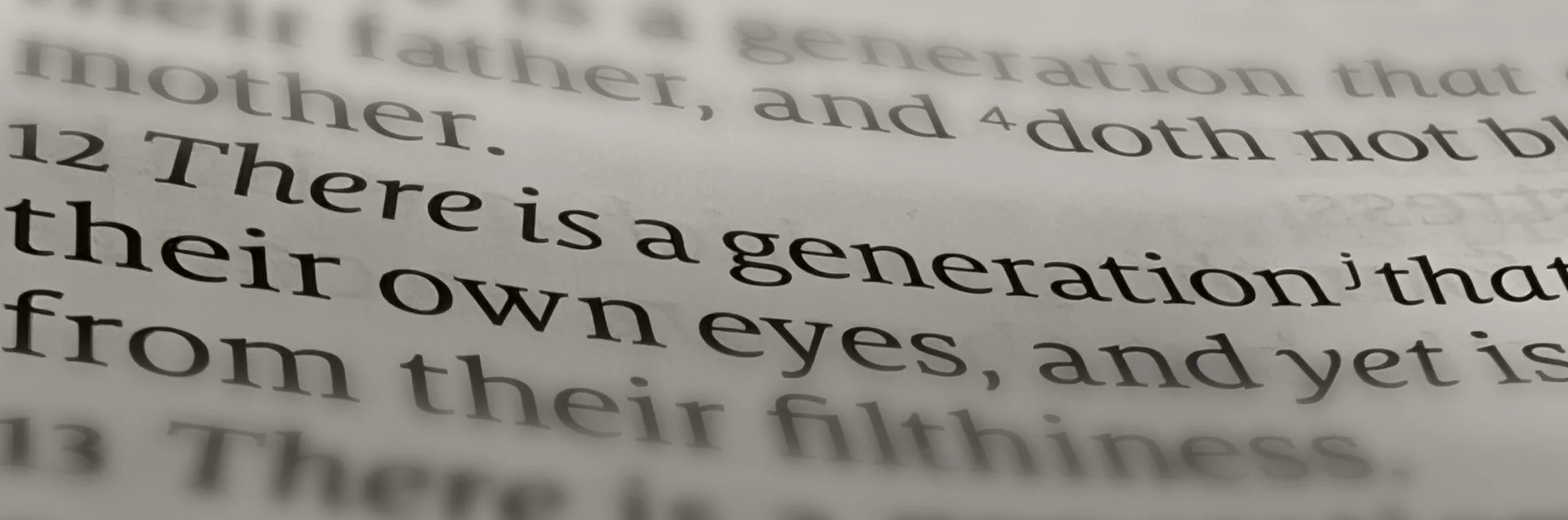
There is a generation that curseth their father, And doth not bless their mother.
There is a generation that are pure in their own eyes, And yet is not washed from their filthiness.
There is a generation, O how lofty are their eyes! And their eyelids are lifted up.
There is a generation, whose teeth are as swords, and their jaw teeth as knives, To devour the poor from off the earth, and the needy from among men.
Proverbs 30:11-14
In Proverbs 30:11–14, could the Bible have been describing our current generation?
Perhaps it describes aspects of every generation, but it does seem that our culture has begun to perfect these four aspects of what the author of Proverbs 30, Agur, was describing.
1. Disrespectful to Parents
“There is a generation that curseth their father, and doth not bless their mother.” — Proverbs 30:11
I understand that far too many parents have done disrespectful things, but even beyond those cases, we see a push in our culture toward disrespect of parents, authority, and elders.
It could be that we need a renewed sense of respect toward those who have come before us. There is wisdom in listening to our parents and elders and learning from those who have already walked the road we are traveling.
A generation that refuses to respect those who came before them will eventually have very little wisdom to pass on to those who come after them.
2. Disinterested in Purity
“There is a generation that is pure in their own eyes, and yet is not washed from their filthiness.” — Proverbs 30:12
We continue to compare ourselves amongst ourselves and have therefore failed to measure ourselves by the standard of God's holiness.
We are a bit like the old saying, “I don't smoke and I don't chew, and I don't go with the girls that do.” We look around, find someone who seems worse than we are, and convince ourselves that we must be doing pretty well.
But God's standard is not other people. God's standard is His own holiness.
We can become very concerned about our outward appearance while neglecting the condition of our hearts. Jesus warned about this very thing when He spoke of those who appeared beautiful outwardly but were inwardly full of uncleanness.
We may be guilty of becoming like whited sepulchers—clean on the outside while there is something very different going on inside.
God is not simply concerned with how we look to others. He is concerned with what is in our hearts.
3. Distinguished by Pride
“There is a generation, O how lofty are their eyes! and their eyelids are lifted up.” — Proverbs 30:13
We have certainly taken pride to its pinnacle in our current generation.
Pride is not a new sin. It goes all the way back to the Garden of Eden. Satan's rebellion was rooted in his desire to exalt himself, and Adam and Eve were tempted with the promise that they could be “as gods.”
At its heart, pride says, “I know better than God. I will determine what is right for myself.”
Our culture has not merely tolerated pride; in many places it has celebrated it. We have even taken something that God condemns and turned it into something to be celebrated.
But pride has always been dangerous. Scripture tells us, “Pride goeth before destruction, and an haughty spirit before a fall” (Proverbs 16:18).
We must beware of the sin of pride—not only the pride we see in the world around us, but the pride that can quietly take root in our own hearts.
4. Devours the Poor
“There is a generation, whose teeth are as swords, and their jaw teeth as knives, to devour the poor from off the earth, and the needy from among men.” — Proverbs 30:14
God loves the poor as well as the rich. Throughout Scripture, we see our Lord's heart of compassion toward those who are unable to help themselves.
But a wicked generation devours and destroys the poor.
And this is not limited to those with little financial means. It can also include those who would be considered a “hindrance to society.”
Some countries have touted the elimination of Down syndrome as a scientific achievement. Yet behind those statistics are individual human beings—children created in the image of God—who were eliminated because they were diagnosed with a condition that some considered undesirable.
We should be careful about what we call an “achievement.”
When our answer to a person who may require extra care is to eliminate the person rather than provide care, we have not solved the problem. We have simply removed the person who was viewed as the problem.
This is wickedness, and it is exactly the kind of behavior Proverbs warns us about.

So What Do We Do About It?
How do we live in a culture like this?
Perhaps we can start by remembering the words of our Lord when He taught us to be the salt of the earth and the light of the world:
“Ye are the salt of the earth... Ye are the light of the world.” — Matthew 5:13–14
Jesus did not tell His followers to hide from the world. Neither did He tell us to become like the world.
He called us to be salt and light.
So don't be afraid to live differently.
Respect your parents. Honor legitimate authority. Pursue genuine holiness rather than merely maintaining an outward appearance. Humble yourself before God. Protect those who are vulnerable. Speak for those who cannot speak for themselves. Love your neighbor. Stand for what is good and right.
We may live in a generation that reflects Proverbs 30:11–14, but that does not mean we have to reflect the generation.
Go ahead and live differently.
We are called to be salt.
We are called to be light.
And sometimes the best way to influence a dark generation is simply to refuse to become part of the darkness.